Emotions Demystified

The guide you were never given

20 min
Go at your own pace — solo or with someone you care about

Who's going through this?

This helps us shape the experience for you.

I'm going through it on my own
We're going through this together

Emotions can feel mysterious, but they do follow some rules.

Knowing these rules makes emotions easier to understand, easier to talk about, and a little easier to navigate.

1
Part 1
How Emotions Show Up
2
Part 2
What Emotions Try to Do
3
Part 3
Where We Have Some Say

How Emotions Show Up

Ever wonder why emotions can hit us out of nowhere?

Our bodies are always busy

Our body (which includes our brain) is always automatically running systems in the background.

Digestion
Immune system

Some systems need our help,
so our body generates signals to let us know

Being hungry. Thirsty. Having to pee. They're all signals from our body to take care of something it needs us to do.

Hunger signal
Need to pee signal

Emotions are also signals

When our body determines something important is around us — dangers, opportunities, losses — it uses emotions to let us know.

Emotional signals can be confusing, but they do always follow certain rules

We'll go through five predictable properties that can help us get a handle on them.

Properties of emotions

1. Our body sends emotions automatically

We don't get to choose when we feel hungry and, in the moment something happens, we don't get to choose our emotional reactions.

*automatic reactions can change over time — we just don't choose them in the moment

2. Emotions are sensations that push us to act

Emotions push us to do things. Click below for examples.

Feel like
Push us to
Signal

3. Emotions change how we think

They make us think following the push is the only logical choice, whether or not that's true.

4. We don't all feel emotions at the same intensity

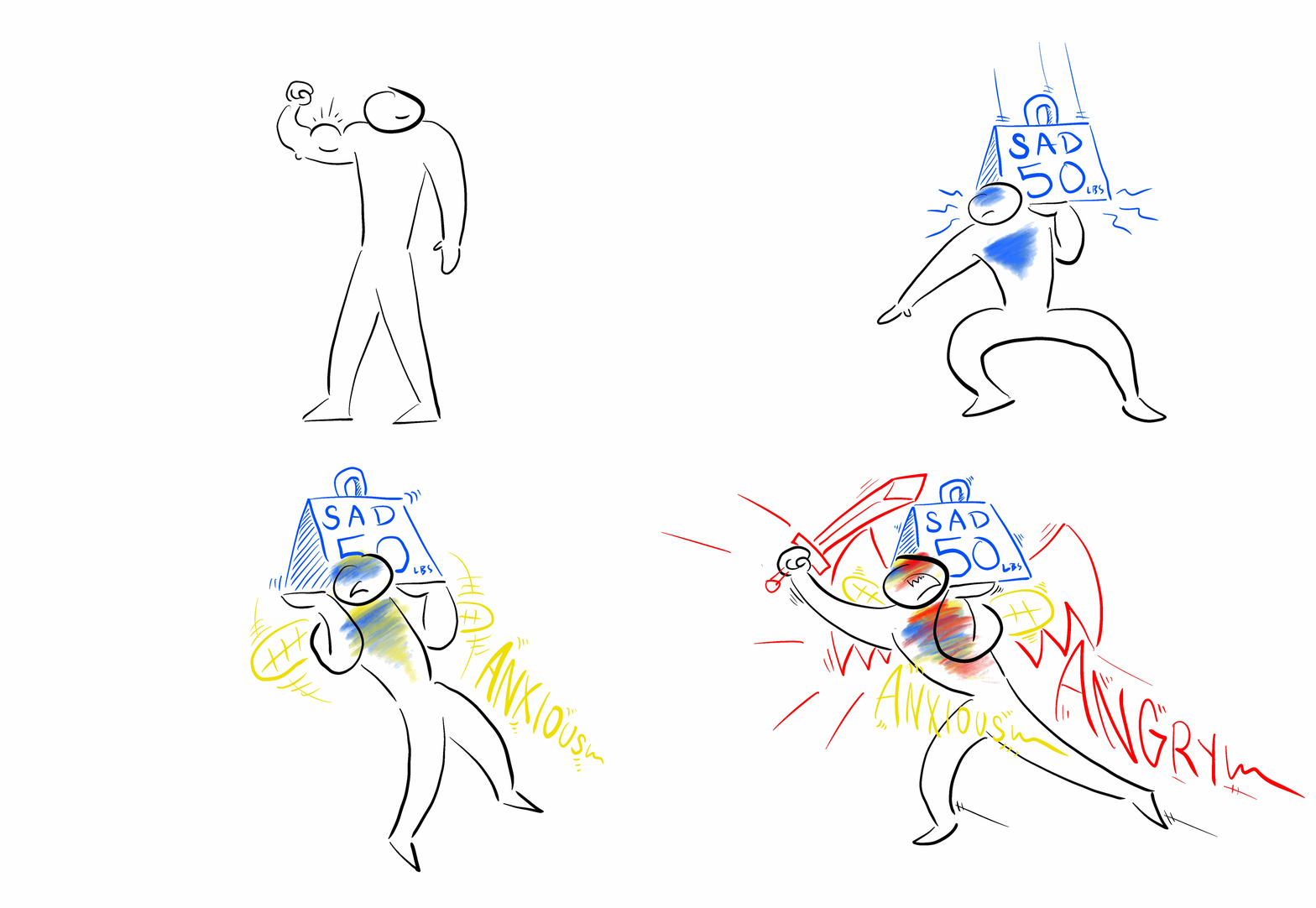
We vary in tons of ways — height, eye color, personality — and in how strong our emotions are. If a push from sadness is like a weight, the same situation can have one person feel 50lbs, and another 300lbs of sadness.

Our body is always figuring out what's going on around us and guessing how strong an emotion we need

Usually it's pretty helpful at helping us navigate the world around us.

Signal strength

Click to change
the risk level

5. Emotions show up in many different ways

They can feel different. Each emotion isn't just one signal. Sadness can feel like:

A weight on our body

a weight on our body

Super tired

super tired

A tight chest

a tight chest

A desire for connection

a desire for connection

We'd call all of these (and many more) "feeling sad." Every emotion is like that.


Mixed emotions

They can be mixed. We might feel angry, sad, and anxious all at once after a good friend moves away.


They can change fast. We can feel sad one moment and angry the next.

Let's apply these ideas to your life

Think of a recent moment when you felt a strong emotion — one you remember clearly. Take a few minutes to bring it to mind.

  1. What did it feel like in your body?
  2. What were the emotions pushing you to do and to think?
  3. What words would you use to describe how you felt? (e.g. sad, angry)
  4. When did the emotion fade?

What Emotions Try to Do

Why would our body give us emotions at all?

Experiences train our emotions

Some off-base reactions are due to genetics or are random. But many are shaped by past experience. Emotions are a marker that something important happened and it should be remembered for next time. So, when we're in a similar situation, our body uses old experiences to guess what emotions to generate.

Past conflict experience
1

If, as a kid, we were around a lot of yelling that made being noticed feel dangerous — our body learns the pattern: "Attention on us = danger."

Fear of speaking
2

Years later, whenever there's attention on us, our body still uses that old pattern, guesses it's dangerous, and generates fear — even though no one will yell at us.

Our body uses information from past experience to make guesses to protect us. Sometimes the situation changes — but the signal doesn't catch up.

Emotions help us survive and thrive

Hunger and thirst push us to do things our body needs to survive. Emotions help us survive by pushing us toward safety and away from danger. And they go further: they help us thrive by giving us info about the world — what to go toward (like what's good for us or what we like) and what to avoid (like what's harmful or we dislike).

Often, emotions are incredibly, often critically, helpful.

Thrive
Survive

But sometimes the signal is off-base

A lot of the time, our body's guess about what's happening and what we need is accurate and helpful. But sometimes, it's not.

Our body isn't perfect — it has many off-base reactions

Think of allergies — our body determines harmless cat fur is a dangerous threat and uses our immune system to attack it. It's like when it determines a harmless spider is a dangerous threat and sends fear to push us to run away.

Allergies poster

Our body wants to help us and protect us — sometimes it can be a little overprotective.

Let's apply these ideas to your life

Emotions aren't good or bad — but they can be helpful or unhelpful depending on the situation. Let's look at some examples from your own life.

1

Think of a time when your emotions were a helpful signal. (Maybe a gut instinct paid off. Or a feeling told you to leave a situation.)

2

Think of a time when your emotions were unhelpful. (Maybe you were pushed to do something you regretted. Or you followed a feeling and it didn't work out.)

Where We Have Some Say

Emotions are automatic but that doesn't mean we're powerless

We can steer our mind's focus, but it also takes effort

We can also intentionally choose where to put our mind's focus — but steering our focus also takes effort and uses energy.

We don't have to follow the push to act — but it takes effort

We can decide NOT to do what we're being pushed to do. But because we're being pushed, not doing it takes effort and uses energy.

When life drains our energy, steering gets harder

Stress, emotions, being sick, not getting enough sleep. Many things drain our energy and make it harder to resist the push to act or steer our minds.

If we're already drained, we might find ourselves responding in ways we don't expect.

Let's apply these ideas to your life

Think of your capacity to manage emotions like a battery. Many parts of life drain it — including emotions themselves. When it's low, emotions are a lot harder to handle.

Press what applies to you. Press multiple times to apply more than once. Tap the orange number to undo.

100%

What recharges your battery?

Now the other side. Add what fills you up.

0%

Making sense of emotions, in a nutshell

Emotions are our body making its best guess about what's happening and what we should do. A lot of the time, that guess is on-point and helpful. But sometimes, it's not.

Part 1 — How Emotions Show Up
  • Emotions are automatic signalsOur body generates them based on what it determines is going on around us — we don't choose which emotions show up or how strong they show up.
  • They are sensations that push us to act — and change how we thinkEmotions are signals. But they are not neutral — just like hunger pushes us to eat, emotions push us to act and change our perceptions to match the push.
  • Emotions show up many different waysA single emotion category — like sadness — can signal different things, feel different, and push us to act in different ways. And often, different emotions can be mixed together at the same time.
Part 2 — What Emotions Try to Do
  • Emotions help us survive — and thriveMost of the time they're incredibly useful. They push us toward what we need and away from what's harmful.
  • Sometimes the signal is off — and that's normalOur body makes guesses based on past experience. Sometimes it overshoots based on outdated information.
Part 3 — Where We Have Some Say
  • We can resist the push and steer our minds — but both cost energyThe stronger the signal, the more effort it takes to not act on it.
  • Our environment affects our capacity to deal with emotionsEmotions add up and affect our capacity. Less capacity means emotions hit harder and are harder to manage.

We don't choose our emotional reactions. But we can choose how we respond — it just takes energy, which is limited.

Mental Design Institute  ·  Making Sense of Emotions

Two quick questions before you go

Your feedback helps us make this better for everyone. Takes about 2 minutes.

Would you recommend or share this with others?

Where do you want to go next?

You've covered the basics of how emotions work. Here are two directions to explore from here.

Walkthrough
When coping backfires
Common ways we try to manage emotions and why they often end up making things worse.
Walkthrough
How to respond (and reshape) our emotions
How our responses can work with our emotions, rather than against them, to shape them for the better.